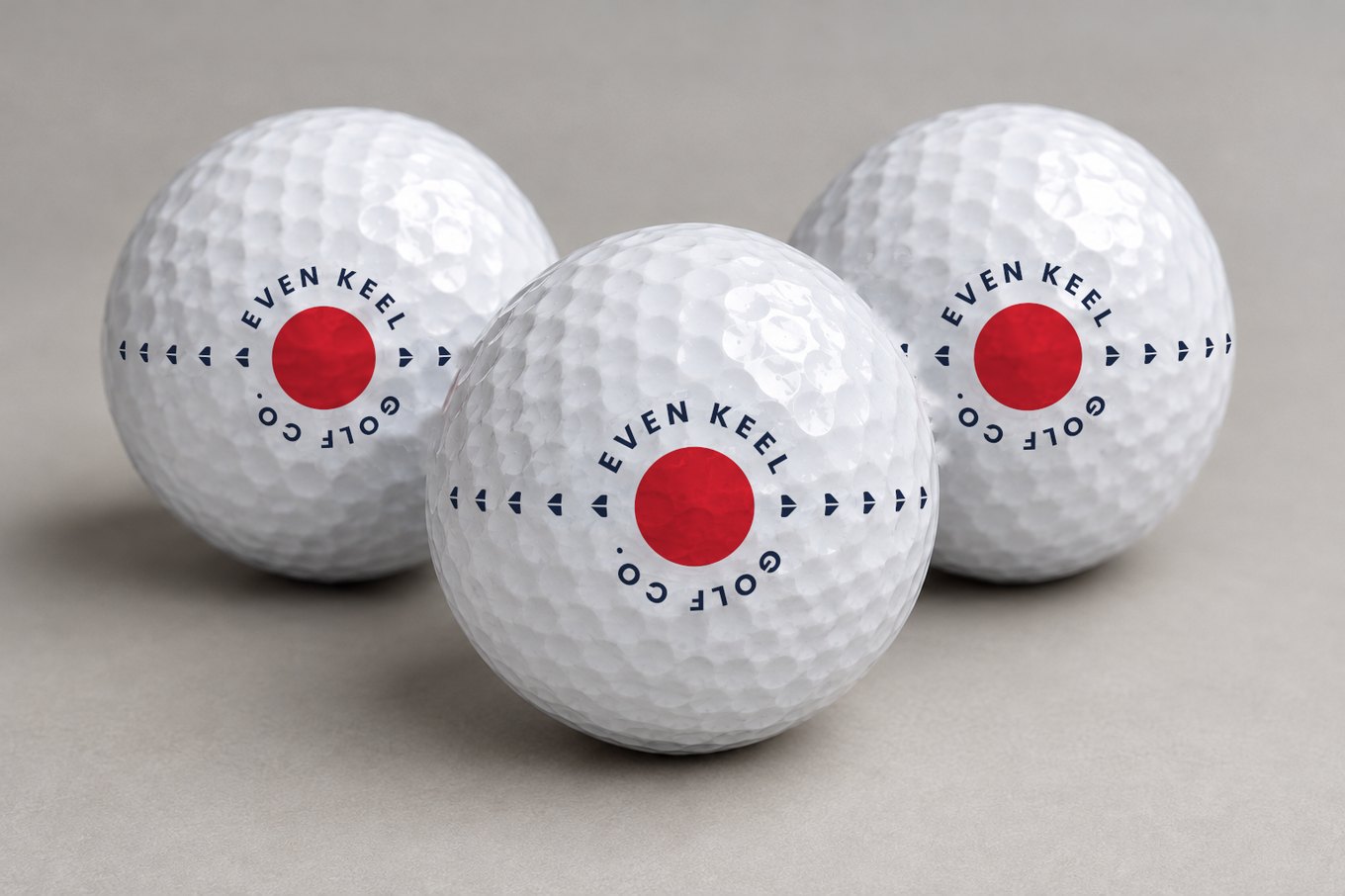
No golf ball is perfectly balanced. But for what premium balls cost, they should at least tell you where the balance is. They don't; the alignment marking goes on with no regard for it.
That's where I come in. I measure every ball, one at a time, and mark the exact axis it rolls true on.
Why "Even Keel"?
When I started down this road, I assumed the alignment marking on a premium ball was placed with its balance in mind. It made sense to me: why print a line on a ball unless it meant something? Then I started floating them, and found out it doesn't. The factory marking goes wherever it looks good, and the heavy side ends up wherever the core happens to sit. That's when I saw the need to balance and mark every ball myself.
Video coming soon
A Callaway Triple Track ball, floated to find its heavy side. The printed Triple Track lines are placed for aiming, not balance, so they don't line up with it.
Golf balls are built in layers, and the core never sits perfectly in the middle. That's what leaves every ball a little heavy on one side.
If the heavy side sits off to one side of your line, it tugs the ball that way a little on every turn, and on a longer putt that can be enough to push it off line. Line it up with your putt and it rolls end over end along your path instead. It's a small effect that matters most on longer putts, but it's one less thing working against you.
Seen from above, with the drift exaggerated. The blue line is the one I print.
Sailors say a boat that's steady and level is on an even keel. That's what I'm after for your putts.
How it works
Most balance tools spin the ball at high speed. I don't. I float each ball in my own solution, with nothing spinning it, rolling it or holding it, so the only thing deciding where it ends up is its own heavy side.
The pull from the heavy side is tiny, and surface tension where the ball meets the surface can easily overpower it. So I go after that two ways: I adjust my solution so balls float as low as possible, with very little of the ball above the surface, and I add a surface-tension reducer to weaken the grip that's left.
Let gravity do the work. The ball floats low and undisturbed until its heavy side points straight down.
Find the top. I pinpoint the exact top of the ball, the light spot.
Print the line. I apply a professional UV-printed alignment marking along the exact pole-to-pole line that runs through the top of the ball, lined up with the heavy spot directly below.
Float it again. After printing, every ball goes back in from a random starting position. It has to settle with its line back on top, running straight, the same as the first time. If a ball can't repeat its result, it doesn't ship.
Clean, check and pack. Each ball gets cleaned and checked for a clean, unbroken line, and every dozen comes with a card on how to line up your putt.
How this compares
My balls are marked for use on the green, for putting. For putting, the line needs to run through the heavy spot, because a slow-rolling ball is pulled by where its heavy spot is and nothing else.
Golfers usually check balance one of two ways: a spinner tool, or floating balls in plain salt water. Both can find a badly balanced ball. But on a good premium ball, the heavy side is so slight that small outside forces can win, and that's where the methods differ.
Spinner tools
The ball spins at thousands of RPM on a powered holder, closer to the spin of a full swing than to a rolling putt, and you mark the line it settles into. At that speed, where it settles depends on how its weight is spread around the spin, not just where the heavy spot is. The two can agree, but not always.
Plain salt water
Floating lets gravity do the work, which is the right idea. But where the ball breaks the surface, surface tension grips the dimples around the waterline. On a typical ball, that grip can be stronger than the pull of the heavy side, so the ball can stop short and the line ends up off.
What I do
I float too, but with the waterline's grip cut down the two ways I described in How it works, so the ball's own heavy side gets the final say.
Not to scale. Gray squares are salt; the red dots are the surface-tension reducer. The heavy side's pull is the same in both; only the waterline's grip changes.
Plain salt water
Video coming soon
My solution
Video coming soon
The same kind of test in each: I mark the top of the ball, then float it again. In plain salt water the ball settles a different way each time, so the marks scatter. In my solution it turns back to the same spot every time. Sped up 2×.
Order
Pick the ball you play and choose a sleeve or a dozen. I buy them new, float and mark every one, and ship them to you.
Pricing is simple: the cost of the ball, plus $3 per ball for balancing, marking and shipping. Same process, same price, whether it's a Pro V1 or a Kirkland.
Last step: pay with Venmo. I'll start on your balls as soon as it comes through.
Yes. The ball itself isn't changed in any way. I just add a line on the cover, the same as marking your own ball.
How do I use the line?
Set the ball down with the line pointing at your target, just like a regular alignment marking. Either end can face the hole.
How long until my order ships?
Within 3 to 5 business days. I do every ball myself, so if things ever get busy I'll let you know by email.
How do I pay?
With Venmo, to @evenkeelgolf. After you place your order, a button opens Venmo with the amount and your order number filled in. Sales tax is added where required.